When you experience a breach, time is crucial. Our 24/7 Security Operations Center responds immediately with precision to eliminate the threat and restore operations.
Your organization has cybersecurity weaknesses and vulnerabilities you don’t yet even know about. They need to be found and found immediately. If you don’t someone else will.
SpearTip Defends℠
You
Livelihoods
Jobs
Careers
Finance
You
Insurance
Law Firms
Healthcare
Education
You
Communities
Governments
IT MSPs
Cloud
You
Infrastructure
Network
The Supply Chain
Critical Infrastructure
You
Research
Intellectual Property
Brand
Reputation
You
Windows
Endpoints
Linux
You
MAC
PII
PHI
SpearTip Defends℠
You
Livelihoods
Jobs
Careers
Finance
You
Insurance
Law Firms
Healthcare
Education
You
Communities
Governments
IT MSPs
Cloud
You
Infrastructure
Network
The Supply Chain
Critical Infrastructure
You
Research
Intellectual Property
Brand
Reputation
You
Windows
Endpoints
Linux
You
MAC
PII
PHI
Virtually anyone can provide you with basic cybersecurity hardware, software and monitoring. What makes SpearTip’s security consulting services different is that we understand the methods, motivations and mindsets of the cybercriminals targeting you. These are not tools you are fighting, they are very highly sophisticated organizations and you need experts on their level to effectively fight them.
SpearTip focuses on the people behind cyberattacks, and are prepared to stop them. SpearTip works tirelessly to defend organizations, livelihoods, shareholder value, jobs, reputations, brands and most importantly, you.
SpearTip Defends℠ MSPs
IT MSPs are a high-value target. Learn how SpearTip teams with MSPs to protect themselves and their clients.
SpearTip Defends℠ Healthcare
Healthcare organizations can’t afford business disruption, learn more about how SpearTip defends healthcare.
SpearTip Defends℠ Finance
It’s more critical in improving your financial institution's cybersecurity environment with recent data breaches.
SpearTip Teams with Insurance
Cyber insurance carriers face challenging problems. Learn how SpearTip teams with carriers to defend their insured.
SpearTip Teams with Legal
Law firms handle complicated legal cases. Learn how SpearTip teams with law firms to defend their clients.
SpearTip Defends℠ Enterprises
ShadowSpear® is designed to meet the challenges of companies' sophisticated and distributed IT environments.
SpearTip Defends℠ Critical Infrastructure
Threat actors are targeting critical infrastructure. SpearTip has designed solutions to address the risks.
SpearTip Defends℠ Manufacturing
Avoid the headlines and downtime, and continue to provide your products for your customers with ShadowSpear.
ShadowSpear® Platform
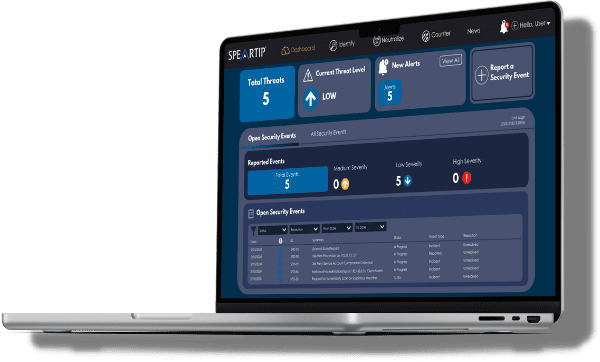
The ShadowSpear® Platform is an unparalleled, proprietary resource that helps you Identify threats, Neutralize malware, and Counter adversaries. The SaaS platform has been deployed on and integrated with hundreds of thousands of systems across the globe, protecting businesses of all sizes from devastating cyber-attacks.
Previous slide
Next slide
Previous slide
Next slide
What Our Clients Are Saying
ShadowSpear supplied us with a complete security package for our cloud. I call it SOC-in-a-box. They came as a complete package to monitor threats and vulnerabilities. So, it replaced any tool we would’ve used. We did not purchase a SIEM; we’re using ShadowSpear. We did not purchase network monitoring software; we’re using ShadowSpear. We did not purchase additional scanners; we’re using ShadowSpear. All of those things that make up an incident response and threat and vulnerability management team in the cloud is for us, ShadowSpear.
Director of Threat and Vulnerability Management, Financial Services
We reached a point where we realized that building our own SOC team wasn’t the best choice for us. Part of it was that we realized that it would take a long time to build out a true SOC team and we wouldn’t be able to effectively support our clients at a reasonable cost.
VP of Technology, Managed Service Provider
We had all the things in place to catch 99.9% of anything that might come in. We had everything in place to catch everything except what ultimately led me to SpearTip. We had an attack from the inside – I had never contemplated it.
Co-Founder, IT Service Provider
The frequency of events was rising, and the attacks were becoming more sophisticated, going from recovering from backups to business crippling attacks.
VP of Technology at a Managed IT Service Provider
Within an hour of me calling them, they were in my network and doing their thing.
Co-Founder of Managed IT Provider
We needed to establish a SOC for the cloud. That means hiring a leader and multiple associates with appropriate skills and implementing multiple tools as we shifted from on-prem to what would be best for our cloud environment. It probably would have taken a year to bring in the talent and new cloud-focused tools, and to develop the necessary APIs, all while keeping up with the implementation we had already begun.
Director of Threat and Vulnerability Management, Financial Services
If I had to hire staff to do these same types of security initiatives, it would cost me two, three times as much as what I’m paying SpearTip to do that. So, it gives me a little more freedom to use those dollars to repurpose and bring in other talents to do things that are going to help move the business forward, financially.
CSO, Healthcare Non-Profit
We didn’t have a dedicated group focused on security, we just had people doing that. And now we just don’t need to do that because SpearTip is such a good partner.
CSO, Healthcare Non-Profit
SpearTip completely saved that investment for me and my partners. I’m going the distance with ShadowSpear.
Co-Founder, IT Service Provider
SpearTip can keep up better than some larger organizations. They’re more like a sports car than a tank – a little bit more nimble, a little bit more agile at this point which is what you need to keep up with cybersecurity right now.
Director of Threat and Vulnerability Management, Financial Services
I was impressed with how [SpearTip] handled things and communicated while they were doing a client’s attack recovery. They were very, very cooperative, and very willing to explain what their software was, what it did, how to work through the incident response plan, what forensic data they actually needed. It was a very different experience than some encounters I had with potential partners.
VP of Technology, Managed IT Service Provider
A service like what SpearTip offers is going to become as normal as the light bill over the next few years. There is no other way.
Co-Founder, IT Service Provider
I like the simplicity of their pricing, an all-in-one monthly per workstation cost. Instead of you worry about how much data was being ingested and net pay for certain levels of service, it is great having an all-encompassing price.
VP of Technology, Managed IT Service Provider
ShadowSpear® has the Power to Fight Back
Experience ShadowSpear® for yourself. Our lightweight, integrated solution will help you sleep easier at night and provide immediate confidence in your security posture. Click below to get a demo today.






















































ShadowSpear supplied us with a complete security package for our cloud. I call it SOC-in-a-box. They came as a complete package to monitor threats and vulnerabilities. So, it replaced any tool we would’ve used. We did not purchase a SIEM; we’re using ShadowSpear. We did not purchase network monitoring software; we’re using ShadowSpear. We did not purchase additional scanners; we’re using ShadowSpear. All of those things that make up an incident response and threat and vulnerability management team in the cloud is for us, ShadowSpear.
Director of Threat and Vulnerability Management, Financial Services